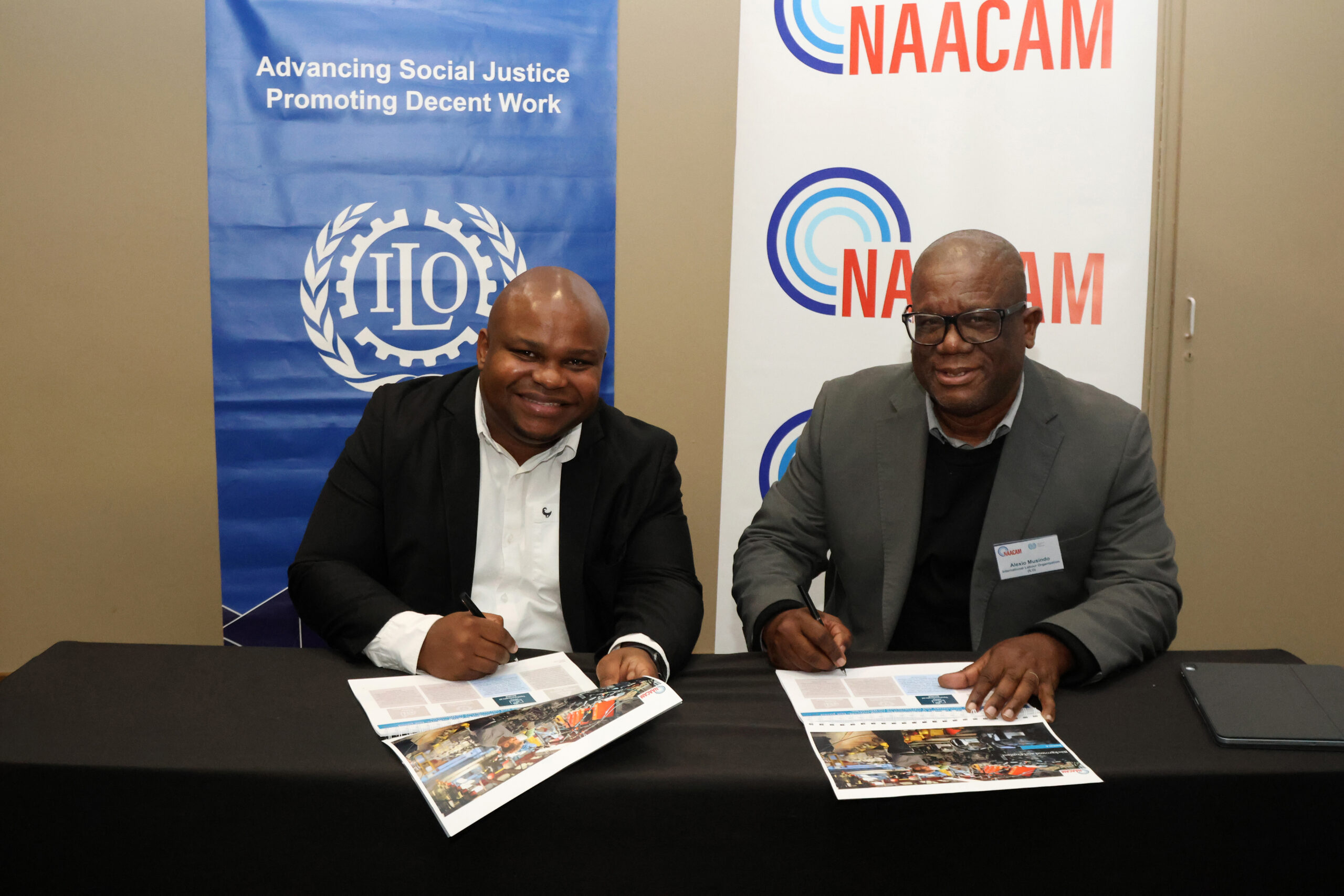
Ndu Chala, Chief Operations Officer at NAACAM (left); with Alexio Musindo, ILO Director for Botswana, Eswatini, Lesotho and South Africa and leader of the Decent Work Team for Eastern and Southern Africa; following the launch of the NAACAM-ILO study examining the employment impacts of South Africa’s transition to new energy vehicles (NEVs). The research highlights both the risks and opportunities for the country’s automotive component manufacturing sector.
Johannesburg, South Africa – South Africa’s transition to new energy vehicles (NEVs) presents one of the most significant industrial shifts facing the country’s automotive sector in decades. Whether that transition results in industrial growth or manufacturing decline will depend on the policy choices and investments made today.
To support informed decision-making, the National Association of Automotive Component and Allied Manufacturers (NAACAM), in partnership with the International Labour Organization (ILO), has launched a new research study examining the employment impacts of South Africa’s transition from Internal Combustion Engine Vehicles (ICEVs) to New Energy Vehicles (NEVs). The study provides a practical roadmap for industry, government and labour to manage the transition while strengthening the competitiveness of South Africa’s automotive component manufacturing sector.
The research highlights both the risks and opportunities facing the industry. Under a severe transition scenario, South Africa’s shift to New Energy Vehicles (NEVs) could place an estimated 8,200 direct jobs at risk between 2025 and 2035. At the same time, the study finds that with the right industrial policies and investment incentives, South Africa has the potential to create approximately 3,370 direct jobs through the localisation of selected new energy vehicle components, including High Voltage Wire Harnesses, Thermal Management Systems and Hydrogen Fuel Cells.
The study also highlights the importance of preparing the workforce for the technologies that will shape the next generation of vehicle manufacturing. While many skills currently used in ICEV component production remain relevant, they will increasingly need to be complemented by capabilities in robotics, artificial intelligence, advanced manufacturing, green production techniques and specialised NEV technologies. The research concludes that South Africa’s skills development ecosystem remains at a basic level of readiness and requires significant investment to meet future industry demand.
Importantly, the report finds that South Africa already has production capability that could be adapted to manufacture several priority NEV components. Realising this opportunity, however, will require stronger demand- and supply-side incentives and accelerated investment in skills development and production capability. Stakeholder consultations also revealed that many local component manufacturers are not yet planning to diversify into NEV component production, citing policy uncertainty, logistical challenges and limited investment incentives as key constraints.
The study recommends six priority actions to support a competitive and inclusive transition:
- Introduce demand-side incentives to accelerate local NEV adoption.
- Strengthen supply-side incentives to encourage investment in component manufacturing.
- Conduct workforce skills audits and establish structured training pathways.
- Expand accredited NEV curricula, training infrastructure and specialist teaching capacity.
- Strengthen the future talent pipeline through improved matric completion and technical education.
- Provide appropriate income support and reskilling opportunities for workers displaced during the transition.
The research was informed by extensive engagement with component manufacturers, vehicle manufacturers, organised labour, government, industry associations, training providers and community stakeholders. It combines employment impact modelling with future skills forecasting to provide practical recommendations for building a resilient, competitive and inclusive automotive industry.
As governments and manufacturers around the world accelerate the transition to cleaner mobility. NAACAM believes South Africa has an important role to play in, and a significant opportunity within, the NEV transition. However, becoming a competitive production location for NEV components will require a well-coordinated effort among all relevant stakeholders to ensure the country’s skills base is prepared to support the transition.
ENDS